Ask whether the target is already known
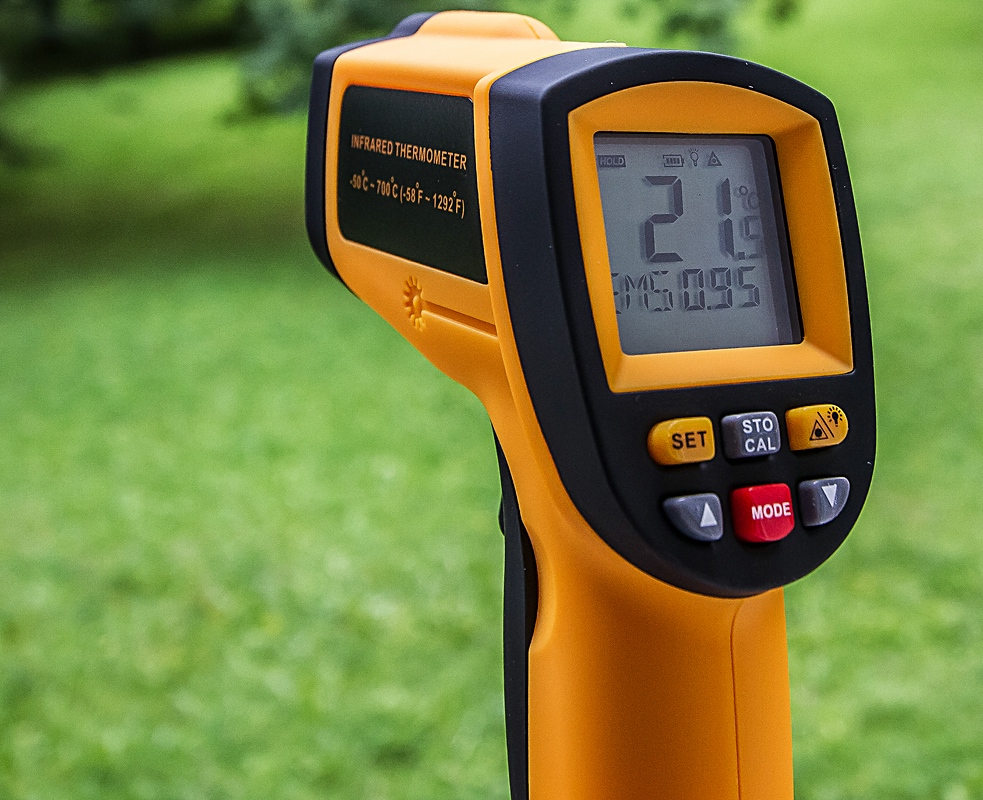
An infrared thermometer is useful when you know which surface you want to check and it is large enough to fill the instrument's measurement area. A thermal camera is useful when you need to locate a temperature pattern: a cold region around a window, an uneven radiator or a warm area on a circuit board.
A camera gives spatial context. It does not automatically give a more accurate temperature than a thermometer. Both depend on the surface, reflected radiation, target size and their measurement specifications.
Match the instrument to the smallest target
The laser on a thermometer is an aiming aid, not the boundary of the area being measured. If the instrument's spot covers a hot component and a cooler background, the reading may conceal the hot component.
A camera can have the same problem when a small target occupies too few detector pixels. For electronics, focus and working distance can matter as much as the headline detector resolution. Check close-focus or macro capability before buying for tiny components.
Price the complete working setup
For a phone attachment, include whether your exact phone, connector and app are supported. Think about a protective case, an extension lead, a stand and the ability to save or analyse files. A standalone camera removes the phone from the capture workflow, but exporting files can still introduce computer compatibility questions.
For UK buying decisions, check the actual seller, VAT treatment, warranty and return terms. Historical prices in reviews are useful context, not today's quotation.
- One known, adequately sized surface: a thermometer may be sufficient.
- Finding an unknown pattern across an area: a camera provides useful context.
- Small electronic parts: prioritise usable focus and target coverage.
- Evidence for a report: check original-file export and analysis before purchase.
Compare both on the same task
The most convincing comparison uses the same surface, distance and conditions, with a suitable temperature reference. A glowing palette or a longer list of functions is not that comparison.
Our source review did not establish a comprehensive independent, controlled camera-versus-thermometer trial for all these uses. Treat this guide as a decision framework; model recommendations need task-specific evidence.
Sources & evidence
A use-case comparison informed by manufacturer guidance and independent author examples. We have not conducted a paired accuracy test or verified current UK product prices.
- Fluke: Getting good results with an infrared thermometerManufacturer guidance / statement
- IRINFO: Point radiometers and spot measurement sizeProfessional guidance
- SDG Electronics: P2 Pro for PCB inspectionExternal author’s report
This guide is based on published sources. We have not conducted the equipment or property tests described by other authors. Statements about compatibility and performance remain scoped to their recorded versions and conditions.
How we use evidence