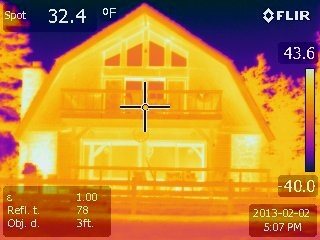
Give heat a chance to reveal the building
A heat-loss investigation needs a useful temperature difference between the building and its surroundings. If the indoor and outdoor temperatures are almost the same, a camera may have little contrast to work with. Recent changes in heating can make the pattern harder to interpret.
RICS describes survey preparation that includes stable heating and attention to temperature difference. The specific values in an author's survey protocol should not be treated as a universal legal threshold or a guarantee that every defect will be visible.
Avoid a picture of yesterday's sunshine
Direct sunshine can warm external surfaces and mask or imitate heat-loss patterns. Wind changes surface cooling, and wet surfaces add another variable. A wall may retain the effect of sun after the sun has moved away.
For an external survey, a suitable evening or early-morning window may be more informative than a sunny afternoon. Consider the orientation of each elevation, recent weather and the materials involved. Windows, reflective cladding and the sky require particular care.
Prepare a short field record
Take ordinary photographs alongside thermograms so the location remains recognisable. Keep the distance and angle practical and repeatable, and preserve the camera's original files where possible. Make a note of room use and anything covering the surface.
For older homes, Historic England emphasises the building history and a comprehensive survey when interpreting thermograms. A solid-wall or historic building should not be treated as a generic modern cavity-wall house.
- Indoor and outdoor temperatures, time and recent heating pattern.
- Wind, rain and direct solar exposure before the survey.
- Building age, known wall or roof construction and accessible areas.
- Camera model, settings, distance, palette and temperature scale.
- A visible-light photograph and a clear location name for each thermogram.
Choose a professional when the decision is consequential
A borrowed camera can help you form better questions. It does not by itself establish why a wall is cold, how much money a repair will save or which construction detail should change.
Earth Notes records useful DIY observations followed by a professional survey that found additional issues. For persistent damp, expensive insulation work, a dispute or unfamiliar construction, seek someone who can interpret the thermal evidence with the rest of the building.
Sources & evidence
Based on published professional guidance and a UK homeowner's record. These are planning principles, not a site inspection, a current standard-compliance assessment or a quantified heat-loss calculation.
- RICS: Conducting a successful thermographic surveyProfessional guidance
- RICS: An introduction to building thermographyProfessional guidance
- Earth Notes: Thermal imaging survey of a houseExternal author’s report
- Historic England: Thermal imagingProfessional guidance
This guide is based on published sources. We have not conducted the equipment or property tests described by other authors. Statements about compatibility and performance remain scoped to their recorded versions and conditions.
How we use evidence